
Canon EOS 40D User Guide: A Comprehensive Overview
This guide details the Canon EOS 40D, offering instructions, specifications, and troubleshooting. Access downloadable manuals, software, and firmware updates for optimal camera performance.
The Canon EOS 40D, a digital SLR camera released in 2007, quickly became a favorite among enthusiasts. This 10.1-megapixel camera offered a significant step up in features and performance compared to its predecessors. Users can find comprehensive instruction manuals online in PDF format, detailing every aspect of operation.
These guides cover everything from initial setup to advanced shooting techniques. Canon provides downloadable software like Digital Photo Professional (DPP) for image processing and the EOS Utility for PC/Mac connectivity. Understanding these resources is key to unlocking the full potential of your EOS 40D.
Key Features and Specifications
The Canon EOS 40D boasts a 10.1-megapixel CMOS sensor, delivering high-resolution images. It features a 3.0-inch LCD screen and a 9-point autofocus system for sharp, accurate results. Continuous shooting reaches up to 6.5 frames per second, ideal for capturing action.
Key specs include ISO 100-3200 (expandable to 6400), and compatibility with Canon EF and EF-S lenses. Downloadable manuals detail these features, alongside information on RAW vs. JPEG settings and image quality options. Firmware updates, available from Canon’s website, enhance performance and add functionality.
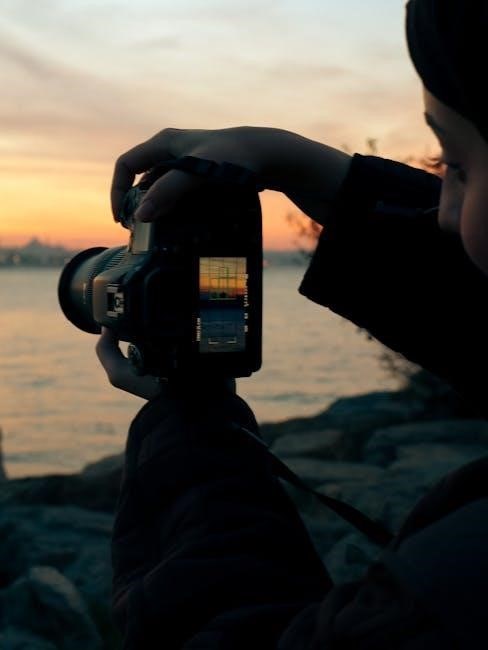
Getting Started with Your Canon EOS 40D
Begin with unboxing, initial setup, and understanding the camera’s body and controls. Formatting memory cards is crucial before capturing your first images with this DSLR.
Unboxing and Initial Setup
Carefully unpack your Canon EOS 40D, verifying all included components are present. These typically include the camera body, battery, battery charger, strap, and various manuals. Insert the battery and ensure it’s fully charged before proceeding.
Next, attach the strap for secure handling. Install a compatible memory card – the camera supports various types. Power on the camera and follow the on-screen prompts to set the initial language, date, and time. Registering your camera online is also recommended for warranty purposes and access to updates.
Understanding the Camera Body and Controls
The Canon EOS 40D features a robust body with strategically placed controls. Familiarize yourself with the power switch, shutter button, mode dial (Auto, P, Av, Tv, M), and control dial.
Locate the menu button for accessing camera settings, and the directional buttons for navigating menus and selecting focus points. The LCD screen displays shooting information and allows for image review. Understand the function of buttons like ‘AF Point Selection’ and ‘White Balance’. The rear control dial facilitates adjustments during Live View and playback. Mastering these controls is key to efficient operation.
Inserting and Formatting Memory Cards
The Canon EOS 40D supports CompactFlash (CF) memory cards. Locate the card slot, usually on the side of the camera, and gently insert a CF card until it clicks into place. Avoid forcing the card.
To format the card, navigate to the camera’s menu – typically under ‘Setup’. Formatting erases all data, so back up important files beforehand. Choose ‘Format’ and confirm the operation. Formatting ensures compatibility and optimal performance. Regularly formatting your card is recommended for reliable image storage and to prevent potential errors during shooting.
Shooting Modes and Settings
Explore various modes – Auto, Program (P), Aperture Priority (Av), Shutter Priority (Tv), and Manual (M) – to control your Canon EOS 40D’s settings.
Auto Modes for Beginners
The Canon EOS 40D offers several automatic shooting modes ideal for beginners. These modes simplify photography by automatically selecting optimal settings based on the scene. Utilize the scene selection mode, choosing from presets like Portrait, Landscape, Close-up, Sports, and Night.
The fully automatic mode handles all settings, ensuring a properly exposed image in most situations. These modes are excellent for learning the basics without needing to understand complex camera controls. Experiment with each mode to understand how the camera interprets different scenes and adjusts settings accordingly, fostering photographic confidence.
Program (P) Mode: Semi-Automatic Control
Program (P) mode on the Canon EOS 40D provides a balance between automatic operation and creative control. The camera sets both aperture and shutter speed, but allows you to adjust ISO, white balance, and exposure compensation. This mode is perfect for situations where you want quick results with some flexibility.
You can shift the program, altering both aperture and shutter speed simultaneously for creative effects. Program mode is a stepping stone towards full manual control, offering a comfortable transition for photographers seeking more involvement in the image-making process.
Aperture Priority (Av) Mode: Controlling Depth of Field
Aperture Priority (Av) mode on the Canon EOS 40D empowers you to control the depth of field in your images. You select the aperture (f-stop), and the camera automatically determines the appropriate shutter speed for correct exposure. A wider aperture (lower f-number) creates a shallow depth of field, ideal for portraits with blurred backgrounds.
Conversely, a narrower aperture (higher f-number) yields a greater depth of field, suitable for landscapes where sharpness throughout the scene is desired. Mastering Av mode allows for artistic control over focus and background separation.
Shutter Priority (Tv) Mode: Capturing Motion
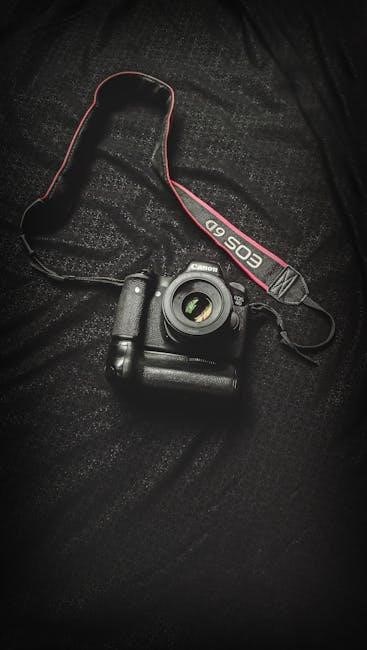
Shutter Priority (Tv) mode on your Canon EOS 40D grants control over how motion is rendered in your photographs. You set the shutter speed, and the camera calculates the corresponding aperture for proper exposure. Fast shutter speeds (e.g., 1/1000s) freeze action, perfect for sports or wildlife photography.
Slower shutter speeds (e.g., 1/30s) blur motion, conveying a sense of movement, ideal for waterfalls or light trails. Experimenting with Tv mode unlocks creative possibilities for depicting speed and dynamism within your images.
Manual (M) Mode: Full Creative Control
Manual (M) mode on the Canon EOS 40D provides complete control over both aperture and shutter speed, allowing for ultimate creative expression. This mode requires a thorough understanding of the exposure triangle – aperture, shutter speed, and ISO – to achieve desired results.
Adjust aperture for depth of field and shutter speed to control motion blur. M mode is essential for challenging lighting conditions or when precise exposure settings are crucial. Mastering this mode unlocks your full photographic potential.

Focusing and Metering
Explore autofocus modes, focus point selection, and metering options (Evaluative, Partial, Spot) to precisely capture sharp, well-exposed images with your Canon EOS 40D.
Autofocus Modes and Selection
The Canon EOS 40D offers a variety of autofocus (AF) modes to suit different shooting scenarios. One-Shot AF is ideal for stationary subjects, locking focus when the shutter button is half-pressed. AI Servo AF continuously tracks moving subjects, maintaining focus as they change position. AI Focus AF automatically switches between One-Shot and AI Servo.
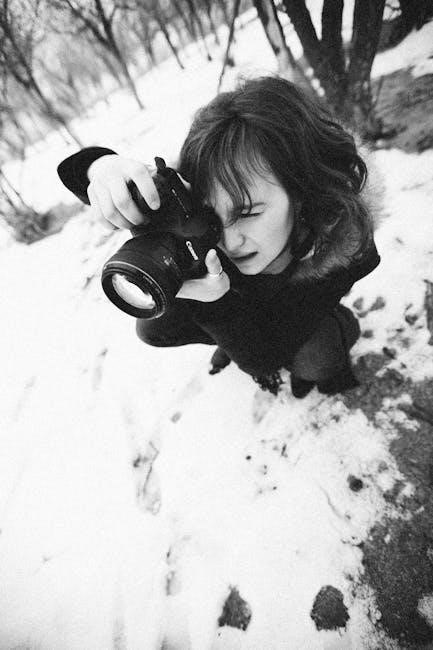
Manual focus is also available for precise control. Selecting the appropriate AF mode is crucial for achieving sharp images. Utilize the AF point selection to pinpoint the exact area you want in focus, ensuring critical details are crisp and clear. Experiment with different modes to master focusing techniques.
Focus Points and Area Selection
The Canon EOS 40D features nine autofocus (AF) points, providing flexibility in focusing on your subject. You can select a single AF point for precise targeting, or allow the camera to automatically choose a point with automatic selection mode. Area selection options include single-point AF, expanding AF point (surrounding points assist), and zone AF (predefined zones).
Understanding these options allows for tailored focusing. Single-point AF excels in static scenes, while expanding AF aids tracking slightly moving subjects. Zone AF is useful for subjects within a defined area. Proper AF point selection dramatically impacts image sharpness and composition.
Metering Modes: Evaluative, Partial, and Spot
The Canon EOS 40D offers three distinct metering modes to optimize exposure. Evaluative metering analyzes the entire scene for balanced exposure, ideal for general photography. Partial metering assesses light from a 6.5% area around the central AF point, useful for backlit subjects. Spot metering measures light from a very small 2.8% area, providing precise control in challenging lighting.
Choosing the correct mode ensures accurate exposure. Evaluative is versatile, partial handles contrast, and spot excels in tricky situations. Experimenting with these modes unlocks creative control over your images’ brightness and detail.
Image Quality and Settings
Explore RAW versus JPEG, image size options, and white balance adjustments on your Canon EOS 40D. These settings significantly impact image quality and editing flexibility.
RAW vs. JPEG: Understanding the Differences
Choosing between RAW and JPEG formats is crucial for Canon EOS 40D users. JPEG files are compressed, resulting in smaller file sizes and immediate usability, but with some data loss. RAW files, conversely, contain all image data captured by the sensor.
This allows for extensive non-destructive editing in software like Digital Photo Professional (DPP), offering greater control over white balance, exposure, and detail recovery; While RAW files require processing, they provide superior image quality and flexibility for professional results. Consider your workflow and editing needs when selecting a format.
Image Size and Quality Settings
The Canon EOS 40D offers various image size and quality options to balance file size and detail. Larger sizes (e.g., 10.1MP) capture more information, ideal for printing or cropping, but create bigger files. Smaller sizes are suitable for web use or email sharing.
Quality settings determine the level of JPEG compression. Higher quality settings preserve more detail but increase file size. RAW format bypasses compression, retaining maximum data. Experiment to find the optimal balance for your specific shooting needs and storage capacity.
White Balance Adjustment
Accurate white balance ensures colors are rendered naturally in your photos. The Canon EOS 40D provides several preset options like Daylight, Cloudy, Tungsten, and Fluorescent, catering to different lighting conditions. Auto White Balance (AWB) attempts to determine the correct setting automatically, but isn’t always perfect.
For precise control, use Custom White Balance, where you set a reference point using a white or gray card. This guarantees accurate color reproduction. Understanding white balance is crucial for achieving realistic and pleasing images, especially in challenging lighting scenarios.

Advanced Features and Functions
Explore customization with Canon’s Custom Functions, Picture Style settings, and the versatile Live View shooting mode for enhanced creative control.
Custom Functions and Personalization
The Canon EOS 40D offers extensive customization through its Custom Functions (CF). These allow photographers to tailor the camera’s operation to their specific shooting style and preferences. CFs control various aspects, from autofocus behavior and image quality settings to button assignments and menu display.
Personalization extends to Picture Style settings, enabling users to define the look of their images with preset or custom profiles. This feature impacts color, contrast, and sharpness. By modifying these settings, photographers can achieve desired aesthetic results directly in-camera, reducing post-processing time.
Picture Style Settings
Canon’s Picture Style settings profoundly impact the final look of your images directly within the EOS 40D. These presets – Standard, Portrait, Landscape, Neutral, Faithful, and Monochrome – offer distinct color and contrast characteristics. Each style adjusts parameters like sharpness, contrast, color saturation, and tone effect.
Beyond presets, users can create and save up to three custom Picture Styles, fine-tuning individual settings to match their creative vision. This allows for consistent image rendering without relying heavily on post-processing software, streamlining workflow and achieving desired aesthetics efficiently.
Live View Shooting
The Canon EOS 40D’s Live View feature enables composing and reviewing images on the camera’s LCD screen, mimicking a point-and-shoot experience. This is particularly useful for precise composition, macro photography, or shooting from awkward angles. Two Live View autofocus methods are available: FlexZone and Quick Mode.
FlexZone allows selecting focus points across a wider area, while Quick Mode utilizes the phase-detection autofocus system for faster performance. However, prolonged Live View use can lead to sensor heating, potentially impacting image quality; a warning will appear when necessary.

Software and Connectivity
Canon provides Digital Photo Professional (DPP) and EOS Utility software for image processing and camera control. Firmware updates ensure optimal performance and compatibility.
Digital Photo Professional (DPP) Software
Canon’s Digital Photo Professional (DPP) is a powerful software suite designed specifically for processing RAW images captured with your EOS 40D. It allows for non-destructive editing, preserving the original image data while applying adjustments to exposure, white balance, color, and detail.
DPP offers advanced features like lens aberration correction, noise reduction, and digital lens optimizer. Users can create custom image recipes for batch processing, streamlining their workflow. The software supports various image formats and provides precise control over image quality, making it an essential tool for serious photographers seeking to maximize the potential of their Canon EOS 40D’s images.
Canon EOS Utility for PC/Mac
Canon EOS Utility is a versatile software application enabling communication between your EOS 40D and your computer. It facilitates image transfer, remote camera control, and camera settings adjustments directly from your PC or Mac.
This utility allows photographers to download images quickly and efficiently, organize files, and manage camera settings like ISO, aperture, and shutter speed remotely. It’s also crucial for firmware updates, ensuring your 40D has the latest features and bug fixes. EOS Utility provides a seamless workflow for image management and camera operation, enhancing the overall photography experience.
Firmware Updates and Installation Guide
Maintaining up-to-date firmware is vital for optimal Canon EOS 40D performance. Canon regularly releases firmware updates addressing bugs, improving compatibility, and sometimes adding new features. Download the latest version from the Canon website, carefully reviewing the release notes for changes.
The installation process typically involves transferring the firmware file to your camera’s memory card and executing the update through the camera’s menu. Always ensure a stable power source during the update to prevent data corruption. Following the provided guide precisely is crucial for a successful installation and continued camera functionality.
Troubleshooting and Maintenance
Resolve common issues with solutions provided, and learn proper cleaning techniques. Regular care ensures longevity and optimal performance of your Canon EOS 40D camera.
Common Issues and Solutions
Encountering errors? The Canon EOS 40D, while robust, can present challenges. A frequent issue is memory card errors; ensure compatibility and proper formatting. Autofocus problems often stem from incorrect mode selection or insufficient light – try alternative AF settings.
If the LCD displays incorrectly, check white balance settings. Battery drain can be addressed by disabling Live View when not needed. For unresponsive buttons, a reset to factory defaults might help. Regularly consult the downloadable instruction manual for detailed troubleshooting steps and solutions specific to your Canon EOS 40D.
Cleaning and Care of Your Canon EOS 40D
Preserve your investment! Regularly clean the Canon EOS 40D’s sensor with a blower to remove dust. Gently wipe the LCD screen with a microfiber cloth – avoid harsh chemicals. Clean the exterior with a soft, dry cloth.
Protect the camera from extreme temperatures and humidity. Store it in a camera bag when not in use. Avoid directly touching the lens surface; use a lens cleaning kit. Proper care extends the lifespan of your EOS 40D, ensuring years of reliable photographic performance. Refer to the manual for detailed cleaning guidance.